Dear Paige

Congratulations! Graduating high school is not a trivial endeavor, and you have done it! Please believe me when I say that many high school seniors put in far more work than some adults I know, and all of the elbow grease you have put into launching Spaceship You (https://www.youtube.com/watch?v=snAhsXyO3Ck) into orbit will take you far. In fact, it may take years before you realize just how much the work you have already done will contribute to achieving escape velocity and reaching the great heights you dream of.

Keep building on that momentum. Inertia and friction are surprisingly strong and subtle forces, and it is far easier to course correct a rocket than to get it off the ground. To that end, I was thinking back to when I graduated high school (it was a while ago, but not -that- long ago!) and what insights and knowledge I wish I had come across earlier that would have added velocity to achieving my hopes and dreams. If I listed them all we would be here until the heat death of the universe, so I will share with you five key insights and four books related to them that have positively impacted my life. I hope these do as much good for you as they have done for me.

You can’t fight your biology

My introverted engineering brain really prefers to logic its way out of problems. Unfortunately, you can’t logic your way out of your biology. The simple truth is we are creatures like any other on this interstellar vessel we call Planet Earth. We are uniquely adapted to life on it, and no amount of thinking or wishing otherwise changes those facts. This means all of the conventional wisdom in this area actually matters and makes a surprisingly big difference:

  • Get lots of sleep
  • Walk every day
  • Drink plenty of water
  • Spend time with people you care about
  • Eat well

I had to relearn these lessons the hard way over the past several years, and this year in-particular I have focused on the last one: eat well. You only get one body, so make sure you nourish it and take care of it the best you can. To this end, I give you Ruhlman’s Twenty. I have found this to be the easiest and most digestible book on cooking techniques for amateur chefs, and the lessons it holds will serve you well for a lifetime.

Happiness is a curve

Enjoy yourself and the fruits of your labor as much as you can in the next few years, as studies show that you will accumulate “complex experiences” rapidly once you hit middle age. It is simply the human condition to experience stress and tragedy in addition to love and joy. Everyone struggles, whether they show it or not. I know this graph can feel discouraging, but know that life’s challenges are shared by all and that happiness waits for you in the end.

On this point I give you Scott Galloway’s The Algebra of Happiness. Scott is sometimes a controversial figure, but the pithy insights he shares in this book have resonated with thousands of readers and made Scott one of the most sought after professors at NYU. Although he talks about the happiness curve, he also shares many other useful pieces of advice for young people that are worth considering.

Money is a tool, not a goal

Life sure would be easier if we had all of the money in the world, right? Well sure, to a point. It is true you absolutely need to achieve some financial stability to avoid the stress of living paycheck to paycheck. But what good is a pile of money once you have a roof over you head, food in your stomach, and some money saved for a rainy day? Figuring out your purpose in life is surprisingly hard, and how much money you actually need corresponds more with your goals and way of life than anything else.

Few things cause stress like not having enough money or understanding how it works. You are probably tired of hearing this, but you also have one great advantage on your side: time. Time is a very important factor in how money can be made to work for you. Learning and employing good financial habits early in life will give you a tremendous leg up, and future you will be thanking you for making smart and meaningful choices.

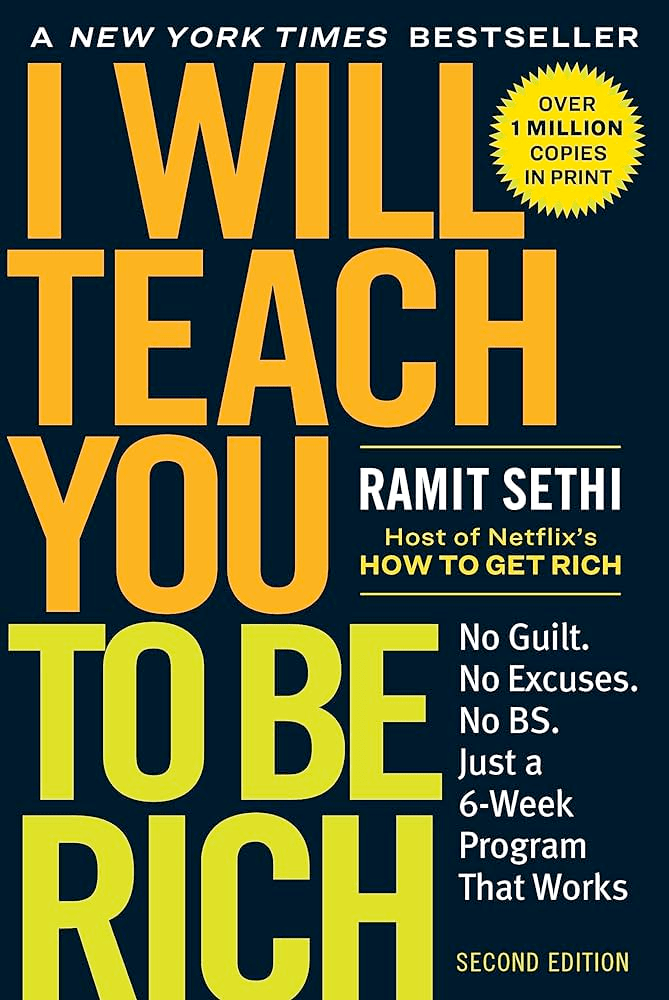
There are many good books in this realm, but Ramit Sethi’s I Will Teach You To Be Rich seems like the best starting point. This book will teach you the basics of everything from credit cards, to 401ks, Roth IRAs, and investing in general. Soak in these words and watch as your stress about money melts away.
When life is hard, consider those who came before

Marcus Aurelius’ rule of Rome was punctuated by near constant war, famine, disease, betrayal, and other hardship. And yet, in Meditations, he shows us how even the most powerful person in the world deals with the same struggles as the rest of us. It is truly incredible how the problems of today mirror those of 162 A.D.

There are many branches of philosophy, but I find few as practically useful as stoicism, and Meditations is one of the greatest works of spiritual and and ethical reflections ever written. When life is hard, consider turning to the stoics for answers. You will find a practical framework of thought regarding your troubles that has stood the test of time. And maybe, just maybe, you will find comfort in the fact that a Roman emperor who lived 1900 years ago was also trying to figure out how to deal with annoying people and procrastination.

Cherish your parents

Your adult life is just beginning, and there is infinite opportunity ahead of you in the vast reaches of space. It is your duty to chart a course, explore, experience new things, and seek challenge and happiness. But don’t forget who made it possible. You come from an awesome family, and your parents have done a tremendous job raising you, supporting you, and helping you build and launch your rocket into space.

This may be hard to imagine, but there will be a time (hopefully in the far distant future) where they won’t be around and you will wish they were. Don’t wait to cherish them. Appreciate them now, today, for who they are, what they have given you, and spend your years soaking up their wisdom to carry wherever life takes you.

Your story is also their story, so make it a good one.

Everything Is Change – The Daily Stoic – Part 19 of 366

Meditate often on the swiftness with which all that exists and is coming into being is swept by us and carried away. For substance is like a river’s unending flow, its activities continually changing and causes infinitely shifting so almost thing at all stands still.

– Marcus Aurelius, Meditations, 5.23

It amuses me to think that Marcus Aurelius was probably also taught Heraclitus’ pithy adages in a similar manner to which we all learn them today considering that, even in Marcus’ time, it was already ancient wisdom given the hundreds of years that separate the two men’s lives.

No man steps in the same river twice.

Everything flows.

The only constant is change.

To some these words are demoralizing. Must everything be fleeting? How does one build a foundation when change is constant? How can you enjoy the moment knowing it won’t last?

To this I would say, consider the opposite. The trials and tribulations of today hardly matter if they are transient. Your failures, real or imagined, will soon be behind you. The discomfort of this moment will pass if you let it.

When life is hard, endure. Change will come to shuffle the board.

When life is good, enjoy as deeply and passionately as possible. Nothing lasts forever.

And perhaps, instead of trying to build sturdy foundations, you would be better served by building sturdy boats instead.

You Choose The Outcome – The Daily Stoic – Part 18 of 366

He was sent to prison. But the observation ‘he has suffered evil,’ is an addition coming from you.

– Epictetus, Discourses, 3.8.5b-6a

The book notes this classic bit of Stoic wisdom: an event is objective. How we describe it and what meaning we give it is on us.

This makes me think of the massive layoffs happening across the gaming industry right now. It is a tumultuous time and has undoubtedly caused great pain, strife, and agony for many. There is no doubt that for many of those affected it is a calamity, an unfairness stricken upon them, a “suffered evil” in the words of Epictetus here. All of this may be true and valid thinking.

But there will be some who use this as an opportunity for change. Maybe they will found a different game studio, try a different role or industry, or take a much deserved break. I firmly believe that the skills learned in the games industry can make a huge impact if applied more broadly in other industries, and I have no doubt for some this will be an inciting incident that will propel them to new heights they would not have imagined otherwise.

The book’s passage concludes, “acceptance isn’t passive. It is the first step in an active process toward self-improvement.” How you define your setbacks will also define you.

Will you be the phoenix or the ashes?

Never Complain, Never Explain – The Daily Stoic – Part 17 of 366

Don’t allow yourself to be heard any longer griping about public life, not even with your own ears!

Marcus Aurelius, Meditations, 8.9

The burdens of responsibility are immense, and it is human nature to want to air your grievances about any given thing. The conventional wisdom even reinforces this: don’t bottle things up, get it off your chest, blow off steam.

How interesting it is then that we know, and have known clearly since Marcus’ time, that venting does no good. A recent study confirms that venting actually can be benign at best and counterproductive at its worst because it essentially elevates the problems in your mind and allows you to ruminate on them more deeply. Rumination is also deeply tied to mental health and depression.

This comes as a timely reminder for me, and it was one of the most important takeaways from Holiday’s The Obstacle Is The Way — it is easy to complain, make excuses and justifications, but it doesn’t do anything, it never lightens the load, and it does not remove the obstacles you face.

Negativity is like a cancer: it multiplies until it destroys the very being that gives it life if it is not stopped in its tracks.

The Strong Accept Responsibility – The Daily Stoic – Part 16 of 366

If we judge as good and evil only the things in the power of our own choice, then there is no room left for blaming the gods or being hostile to others.

– Marcus Aurelius, Meditations, 6.41

In the world of business there is a key trait that is highlighted in just about every book on leadership and company culture: as a leader you take blame and give praise. Complaints go up the chain of command, not down. This doesn’t mean as a leader you don’t provide guidance, feedback, corrections, and so on, but you must internally learn to differentiate between what is venting and complaining and what is valuable, actionable feedback for your team and organization. The most successful leaders accept responsibility, often without praise and accolades.

Given this, I am always drawn back to a thought exercise I went through in business school which, while it has some eerie dystopian capitalist overtones, I think is useful for many people who have never thought of life this way. Imagine your life a business, and you as the CEO. You must make strategic decisions, and over your life you will likely command millions in revenue from salaries and other sources. You have to choose when and how to invest in your team (that’s you, and your partner if you have one), which opportunities to take and ignore, how to manage your cost structure, and figure out how to deal with the many obstacles that face your nascent enterprise.

You are the the CEO of your life. You are the top of the chain of command. The buck stops with you. It is your choices and actions that will guide the outcomes.

The responsibility is yours.

This Should Be Quick & Easy™

During a recent lunch conversation with my colleagues we discussed the idea that you often cannot easily see the world from another person’s perspective because you cannot unlearn what you know or remove your biases completely. In engineering this sometimes manifests with senior team members (including me, to my shame) sometimes saying, “Oh, this is will be quick and easy” without necessarily explaining why because the answer seems so obvious.

But it isn’t obvious. Not to everyone. And if you quickly chime in that a problem is trivial then you’ve potentially set off spurious thoughts in other team members that are unhelpful. Wait, why is that easy? It doesn’t seem easy. I must be missing something. Or maybe I just suck.

Obviously this is not the intent of the comment. In fact, we think we’re helping! We assume in a perfect world people will always ask questions and feel safe in doing so, but the senior team members have transferred the onus to the junior team members in this scenario. Worse still, they have potentially robbed them of a learning opportunity based on their personality and gumption.

The lesson here is a simple one, but it is still hard for me. That is why I have it on a sticky note on my monitor during video calls.

Listen more and speak less.

Provide intent, not instruction.

Don’t chart the course, but course correct.

Depression is a disease of civilization

Depression is hard. I have found it can be nearly impossible to explain and convey the gravity of it to people who have never experienced it themselves or with those they care about. For those unfamiliar it is easy to see laziness or apathy, but for those struggling its hard to explain why the simplest tasks are insurmountable. Why taking out the trash or going for a walk or checking the mail takes every ounce of power you can muster. You’re spent and you aren’t sure why. Everything little thing feels impossible.

I remember when I first watched this talk by Dr. Stephen Ilardi ten years ago, and as someone who was struggling with depression it really made me challenge my assumptions about my struggles. When he talked about depression being nearly non-existent in hunter gatherer societies even to this day it has to make you wonder as he did: why is that? How is that possible? Rates of mental health issues have increased dramatically over the last 50 years and show no signs of slowing, and yet we have more research than ever on the topic.

Everyone’s struggle is different and I suggest anyone who is struggling to seek help and connection, but I can say for myself that his hypothesis and advice was apropos. Modern life removes a lot of the struggles we are biologically adapted for, and that leaves us with mental and physical gaps to fill. If you don’t need to find your food yourself then your brain will start to equate that struggle with your DoorDash order. With so much spare time you turn your phone into a job with endless social media apps to scroll, notifications to read and clear, and numbers to make go up or down as your dopamine demands. Since the web is infinite you can do this endlessly, and you lose sleep in search of the next cat video that will make your brain tingle for 15 seconds. You become “busy” and don’t see your friends because you feel like crap and become overwhelmed. The cycle turns into a death spiral.

I don’t mean to trivialize, but these are modern invented problems only made possible by the advancements of civilization. Our biology isn’t adapted to spend 14 hours a day on a screen. You need the sun and nature. You are a social creature no matter how introverted you are. Your brain is wired for connection. Your brain needs challenging and creative work the way your muscles need movement. Without it you will atrophy.

I have spent the last few years working diligently on becoming the best version of myself, and the results have dramatically exceeded what I would have predicted when deep down in the depths of depression. If I could sum up my biased n=1 personal experiment it would largely follow Dr. Ilardi’s advice:

  • Sleep well
  • Move more
  • Challenge your brain
  • Prioritize social connection
  • Provide value to others
  • Play with the world

Put the screen away, go outside, and follow where your feet take you. That is where the world is.

Building A New Computer – Part 1

Once upon a time I would either build or help others build a new computer once or twice a year. These projects were always fun and interesting, and I normally enjoyed each step in the process. Trying to build with a budget in mind and get the best bang per buck, and ensuring compatibility and optimal performance in an era that predates PC Part Picker added an extra layer of nerdy challenge.

However, as time went on my friends and I stopped building as much. Getting older meant we had the opposite problem as our younger selves: more money but less time. This made buying pre-builts more appealing. Others (myself included) fell into another bucket: the gaming rig simply didn’t need upgrading.

I think young me really enjoyed more demanding games. I was still young in the nascent era of hyper-realistic first person shooters that started to require serious hardware to perform. But older me is putzing around in games like Stardew Valley, Guild of Dungeoneering, Dome Keeper, and Monster Hunter Rise. Although all impressive in their own ways, most are many years old and the only 3D title (Monster Hunter Rise) was built to run on the Nintendo Switch which had low specs even when it launched in 2017. None of these games are very demanding. In fact, I have yet to run into anything I want to play on the Steam Deck that it can’t handle in a way I find acceptable.

Truly I have become less discerning over time, but there is also simply so much more choice in what to play and lots of good games do not require that much computational horsepower. This has lead me to keeping Typhon, my main computer, for far longer than I ever expected.

Typhon was built in November 2011. Little did I know that the Intel i7-2600k (there were no i9’s in this era) would be a real champion. Over the 11 years of Typhon’s existence I have had numerous hardware failures: broken hard drives, dead RAM sticks, the NIC on the motherboard, and two GPUs. But the i7-2600k continues to perform to this day. I think it is clear that the processors Intel produces are very likely to outlive the components they slot into, and I worry the day will come that the ASUS P8Z68-V PRO motherboard will finally give out and not be cheaply replaced.

There have been hints of Typhon showing its age over time, but with some maintenance and modernization I’ve always managed to go further than expected. In 2011 when the machine was built you could get a 120GB SATA III SSD for $150. Over the course of three operating systems (Win7, Win 8, and Win10) this really turned out to be not enough. Now you can get 1TB for $70, or $100 if you want a DRAM cache included. As my GPUs died or became otherwise insufficient (I’m looking at you Witcher 3), it was always easy to upgrade and the difference in performance between PCIe 3.0 and PCIe 4.0 for GPUs is basically non-existent. Last year during an unfortunately timed GPU replacement I was “forced” to buy a 1TB M.2 NVME SSD PCIe 4.0 drive as part of a Newegg Shuffle. Given that my rig was over 10 years old it had me thinking about upgrading, but it turns out there are very cheap PCIe 3.0 adapters for an M.2 drive, and this breathed a whole new life into my long lived gaming machine. Never before had I felt such speed and responsiveness, and it had nothing to do with my CPU.

Although Typhon continues to work admirably, the weight of a hundred small things have added up, and I was just waiting for a push into the upgrading camp. With the addition of the M.2 drive I thought upgrades would be a few more years out, and they could be. The only time I’d really maxed out the i7-2600k was when downloading games on Steam. With a gigabit WAN connection the CPU actually cannot process data fast enough to feed it from the NIC to the M.2 SSD. Strangely the storage and the network are now faster than the CPU during sustained max throughput. But even that I can live with. It is not necessary to download games at gigabit speeds. Ultimately, Microsoft and Windows 11 are my culprit. Typhon predates TPM 2.0 being released, and unless Microsoft relaxes this rule then Typhon will remain on Windows 10 forever (or something more drastic).

Separately from Typhon I also run a little Ubuntu server called Hermes. It was built to be an always-on box used for hosting game servers, software development, and other linuxy things. This computer too has started to show its age and wane in usefulness. Over time we migrated away from Ventrilo and Mumble servers to Discord. We’ve stopped playing the various Minecraft servers, but we may come back to them some day. And, somewhat to my surprise, the small hard drives and SSDs in this machine are actually not big enough to do some of the computing tasks I’m interested in doing. The only thing this server now runs is FoundryVTT, and that hardly warrants a separate machine running 24/7.

With the writing on the wall for both of these machines I started to reintegrate myself into the computer building hobby, and it was like reconnecting with an old friend. It was so great to catch up and see all of the changes that have been made over the past 5-10 years that I have not been paying particularly close attention to. PCIe 5.0 is here! These NVMEs really -are- that snappy! CPUs have so many cores now! Most computer cases don’t have 5.25″ bays anymore! There are motherboards that cost $1500!? And literally everything has RGB.

Of course I knew of these things, but using a Macbook Pro at work for the last 7 years and not upgrading my gaming rig really led me to have a shallow understanding of the space. And, honestly, that was nice. There is no reason to keep up with the computing hardware horse race if you are happy with what you have, and I think people throw out computers for more frequently than they should. In a world with so much e-waste we really should be more concerned about having a computer that meets our needs than having the latest and greatest every few years.

Now is also a unique moment in time. AMD just launched Zen5 CPUs, Intel is launching Raptor Lake CPUs in three days, PCIe 5.0 is rolling out, and there are new GPUs from Nvidia, Intel, and AMD all dropping right now during a period of low demand across the board.

It is finally time to build a new computer.

It’s Not The Thing, It’s What We Make Of It – The Daily Stoic – Part 15 of 366

When you are distressed by an external thing, it’s not the thing itself that troubles you, but only your judgement of it. And you can wipe this out at a moment’s notice.

Marcus Aurelius, Meditations, 8.47

The book’s example after this quote is about Franklin Delano Roosevelt. He spent his whole life dreaming and preparing for his career in politics, but at 39 he got polio. Did he let this horrible disease, an “external thing,” end his hopes and dreams of winning the presidency? We all know the answer given that FDR is widely regarded as one of the greatest political figures in American history.

This one also hits home for me. As we’ve touched on in the past, it is easy to feel like life was unfair in the hand it dealt you and then use that as fuel to generate a myriad of reasons why you don’t have what you want. My dad became disabled when I was in fourth grade. My mother got breast cancer a couple years later, and she died when I was in eleventh grade. My maternal grandfather died that same year. The knock on effects of these events were huge. Almost everything in life changed in some way. My entire childhood was defined by these events, and they were all outside of my control.

It took me a long time to make my peace. Ultimately the feelings of worry, anger, stress, disdain, and sadness were generated from within, and they were holding me back. Changing how I thought about these things very likely saved my life, and only now am I able to look back and see how fortunate I still was in so many ways.

The book ends with the line, “Let’s not confuse acceptance with passivity.” This is an important note. The idea is not to invalidate your feelings, to ignore things, or not to care. It is not about lack of agency, or abdicating your desires and ability (and responsibility) to act. From my view, you should experience the emotions as they come to you. It is good to be sad when sad things happen. But don’t get stuck and dwell on it for too long.

Time moves on, and so should you. Accept the things you cannot change.

Always The Same – The Daily Stoic – Part 14 of 366

Think by way of example on the times of Vespasian, and you’ll see all these things: marrying, raising children, falling ill, dying, wars, holiday feasts, commerce, farming, flattering, pretending, suspecting, scheming, praying that others die, grumbling over one’s lot, falling in love, amassing fortunes, lusting after office and power. Now that life of theirs is dead and gone… the times of Trajan, again the same…

Marcus Aurelius, Meditations, 4.32

It is easy to think we now live at the apex of human society, with our impressive technology and handful of accomplishments truly defining of our species. The Industrial Revolution. The invention of flight. The moon landing. The Internet.

But, truthfully, evolution takes a long time to occur. It takes a duration so long it is not easily comprehended by humans. Humans today are not appreciably different from humans 50, 100, or 1000 years ago. Sure, we have more technology and knowledge at our finger tips, but that largely does not change who and what we are. As Marcus Aurelius points out, we largely do what our ancestors did. Our ancestors will do largely what we do. Per the book, “With a few exceptions, things are the same as they’ve always been and always will be.”

We are all, for a brief time, passengers on the starship of Earth. It was here long before we were born, and it will be here long after we are gone. Radical change is not in the cards. Humans are humans, and they do what humans do. Make your peace with that and you improve your chances of a pleasant journey through the cosmos.