Turbo and Throttle

Most of the time the processor in your computer is doing very little work. In fact, as you read this, it is probably sitting close to idle. The work demanded of it is often tiny compared to what it is truly capable of when it runs full tilt. Modern processors have base clocks and turbo modes to reflect these dual demands.

When work is light a processor sits at its base clock trying to be as energy efficient as possible. When work is hard it runs at its turbo frequencies for as long as it can manage until the work is complete. This often results in a very spiky existence for the processor as it oscillates between dreadfully long periods of doing nearly nothing and often relatively brief (but sometimes continuous) bursts of all out demand for optimal performance.

On the other hand, if a processor has insufficient cooling or suffers from other environmental factors (like being directly in sunlight for a long time), it will begin to thermal throttle. This is a feature designed to prevent the chip from harming itself, and potentially other valuable components, if it is going to exceed its thermal capacity for too long.

This means that the processor eventually finds equilibrium at maximum sustained performance given its thermal realities. In a perfect world (with good cooling) it can and will run at full tilt forever as it sheds heat into an environment capable of dissipating it effectively, but in the worst case it will shut down all together (such as when the heatsink is removed) which stops any work from being done.

Technology often mirrors life since it is made by humans for humans, and these concepts translate directly into how people operate. In knowledge work the demand is often spiky like that of a processor. We may be chugging along performing our work as normal before a new initiative kicks off and soaks up all of the available bandwidth from a team. Depending on the circumstances, this may cause people to go from from their normal work output into turbo mode. If teams or individuals run in turbo mode for too long, they burn out unless throttling is introduced.

This scenario is actually an example of optimal stopping theory. If a team or individual operates at 100% of their ability at all times then there is no scenario in which they can respond to a spike in demand or change of circumstances without dropping something else they were doing which was already important. However, you also don’t want anyone sitting around idle.

How much capacity should generally be utilized? When do you introduce throttling?

This depends on the nature of the work and the environment the team or individual finds themselves in. If the work is well understood and consistent then maybe you can survive closer to the 100% threshold, but the less clear and less consistent the work the more you need to build in some reserve capacity. This idea was somewhat infamously explored by Donal Shoup‘s book The High Cost of Free Parking. He proposed the idea that parking utilization should be around 85% to be optimal, and that introducing parking fees to achieve this this would reduce traffic congestion, fuel waste, and time waste (thus saving more than the fees paid) while raising revenue for the city by removing free parking. For the cities that have tried it, it appears to work.

This seems close enough to the 80/20 rule (known as the Pareto principle) to help us here. We should strive to consistently operate around 80-85% of our possible capacity. This leaves us room to turbo when necessary, but also means we are never idle and not providing value. When I say these numbers I don’t mean just at work, but your total capacity as a human being. When one of my team members had a sudden loss in the family that obviously demanded many of his cycles, and that meant he had less cycles to use elsewhere for a time. Try to quantify the demands life has of you and be realistic about what that means for where you spend your cycles.

If an individual or team is consistently above this threshold then they (and leadership) need to consider two things:

  1. Throttle before you burn out. This will feel impossible when the workload is at its peak with no end in sight, but it simply must be done for the good of all. Take some PTO, find ways to relax and de-stress, and see if any of the work can be better balanced among teams and individuals.
  2. Increase capacity and/or shed workload. For a team this is obvious: if there is important work not getting done then see if you can delegate this (or less important) work or hire more people. For individuals this is a little harder. Are there improvements to the workflow or process you could make? Would training help you be more efficient? Is there other low value work eating up your cycles that you could stop doing? Can you partition the tasks differently such that more people can contribute?

America treats working yourself to the brink as a rite of passage, but as a recovering workaholic who has gone beyond all limits several times I assure you it is sub-optimal just like free parking and infinite turbo. When you run out of juice and force a shutdown you halt everything, and the damage of this scenario can be extreme.

You do not provide value to your team, your organization, your family, or yourself if your burn out.

To be a consistent high performer you must learn and respect your actual capacity. To be a good leader you must stop individuals and teams from running too hot for too long while also making sure no one is idle.

If you are turboing right now without an end in sight, consider when to start throttling. Taking care of yourself is not defeat. On the contrary, it is the most optimal thing you can do.

Dear Paige

Congratulations! Graduating high school is not a trivial endeavor, and you have done it! Please believe me when I say that many high school seniors put in far more work than some adults I know, and all of the elbow grease you have put into launching Spaceship You (https://www.youtube.com/watch?v=snAhsXyO3Ck) into orbit will take you far. In fact, it may take years before you realize just how much the work you have already done will contribute to achieving escape velocity and reaching the great heights you dream of.

Keep building on that momentum. Inertia and friction are surprisingly strong and subtle forces, and it is far easier to course correct a rocket than to get it off the ground. To that end, I was thinking back to when I graduated high school (it was a while ago, but not -that- long ago!) and what insights and knowledge I wish I had come across earlier that would have added velocity to achieving my hopes and dreams. If I listed them all we would be here until the heat death of the universe, so I will share with you five key insights and four books related to them that have positively impacted my life. I hope these do as much good for you as they have done for me.

You can’t fight your biology

My introverted engineering brain really prefers to logic its way out of problems. Unfortunately, you can’t logic your way out of your biology. The simple truth is we are creatures like any other on this interstellar vessel we call Planet Earth. We are uniquely adapted to life on it, and no amount of thinking or wishing otherwise changes those facts. This means all of the conventional wisdom in this area actually matters and makes a surprisingly big difference:

  • Get lots of sleep
  • Walk every day
  • Drink plenty of water
  • Spend time with people you care about
  • Eat well

I had to relearn these lessons the hard way over the past several years, and this year in-particular I have focused on the last one: eat well. You only get one body, so make sure you nourish it and take care of it the best you can. To this end, I give you Ruhlman’s Twenty. I have found this to be the easiest and most digestible book on cooking techniques for amateur chefs, and the lessons it holds will serve you well for a lifetime.

Happiness is a curve

Enjoy yourself and the fruits of your labor as much as you can in the next few years, as studies show that you will accumulate “complex experiences” rapidly once you hit middle age. It is simply the human condition to experience stress and tragedy in addition to love and joy. Everyone struggles, whether they show it or not. I know this graph can feel discouraging, but know that life’s challenges are shared by all and that happiness waits for you in the end.

On this point I give you Scott Galloway’s The Algebra of Happiness. Scott is sometimes a controversial figure, but the pithy insights he shares in this book have resonated with thousands of readers and made Scott one of the most sought after professors at NYU. Although he talks about the happiness curve, he also shares many other useful pieces of advice for young people that are worth considering.

Money is a tool, not a goal

Life sure would be easier if we had all of the money in the world, right? Well sure, to a point. It is true you absolutely need to achieve some financial stability to avoid the stress of living paycheck to paycheck. But what good is a pile of money once you have a roof over you head, food in your stomach, and some money saved for a rainy day? Figuring out your purpose in life is surprisingly hard, and how much money you actually need corresponds more with your goals and way of life than anything else.

Few things cause stress like not having enough money or understanding how it works. You are probably tired of hearing this, but you also have one great advantage on your side: time. Time is a very important factor in how money can be made to work for you. Learning and employing good financial habits early in life will give you a tremendous leg up, and future you will be thanking you for making smart and meaningful choices.

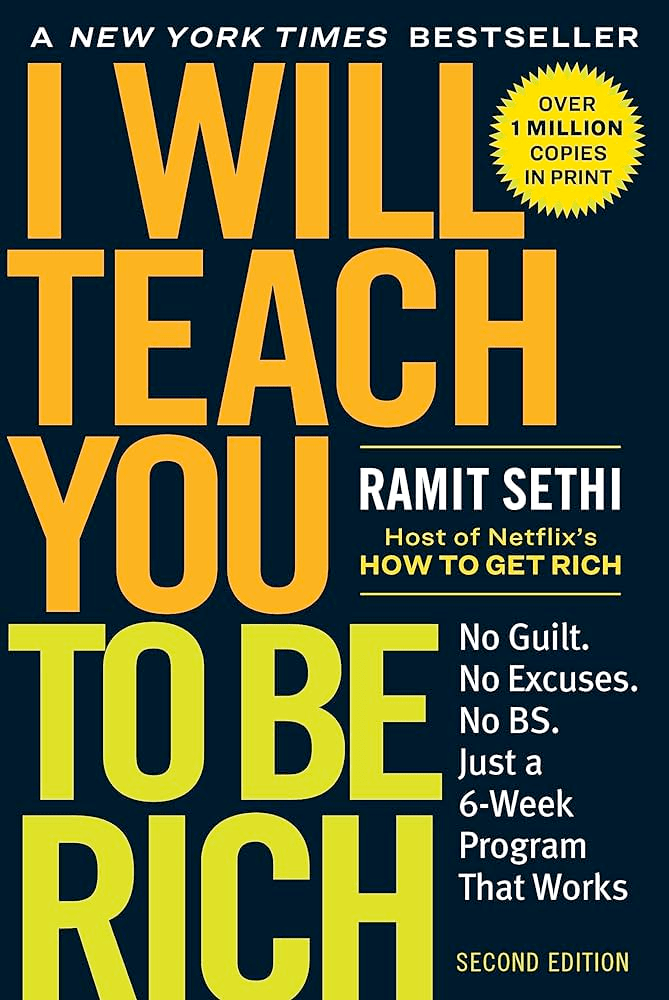
There are many good books in this realm, but Ramit Sethi’s I Will Teach You To Be Rich seems like the best starting point. This book will teach you the basics of everything from credit cards, to 401ks, Roth IRAs, and investing in general. Soak in these words and watch as your stress about money melts away.

When life is hard, consider those who came before

Marcus Aurelius’ rule of Rome was punctuated by near constant war, famine, disease, betrayal, and other hardship. And yet, in Meditations, he shows us how even the most powerful person in the world deals with the same struggles as the rest of us. It is truly incredible how the problems of today mirror those of 162 A.D.

There are many branches of philosophy, but I find few as practically useful as stoicism, and Meditations is one of the greatest works of spiritual and and ethical reflections ever written. When life is hard, consider turning to the stoics for answers. You will find a practical framework of thought regarding your troubles that has stood the test of time. And maybe, just maybe, you will find comfort in the fact that a Roman emperor who lived 1900 years ago was also trying to figure out how to deal with annoying people and procrastination.

Cherish your parents

Your adult life is just beginning, and there is infinite opportunity ahead of you in the vast reaches of space. It is your duty to chart a course, explore, experience new things, and seek challenge and happiness. But don’t forget who made it possible. You come from an awesome family, and your parents have done a tremendous job raising you, supporting you, and helping you build and launch your rocket into space.

This may be hard to imagine, but there will be a time (hopefully in the far distant future) where they won’t be around and you will wish they were. Don’t wait to cherish them. Appreciate them now, today, for who they are, what they have given you, and spend your years soaking up their wisdom to carry wherever life takes you.

Your story is also their story, so make it a good one.

High Performers Double Check Their Work

It seems simple and obvious. However, I seem to have this discussion with seemingly everyone, so I’m going to assume this is actually some secret sauce that I have uncovered: the quickest and easiest way to up your skill level is to double check your work.

I think math class burned the phrase “check your work” into our minds with some negative connotations. I also think people are just generally trying to move too fast, and attention to detail really suffers in an era of incessant multitasking. Doing something 80% or 90% of the way may be good enough, but good is the enemy of great. If you want to be a high performer and to have a sterling reputation then you need to set the quality bar high and keep it there. If you hand off work that is actually incomplete or wrong then you gum up the works, you look unprofessional, and you waste valuable time and money. Don’t make people double check your work for you unless that is what they are literally paid to do (i.e. editors, auditors, etc). Even then, your goal is to make their lives as easy as possible so they can work efficiently instead of cleaning up stuff you could have caught yourself.

One of the great things about this piece of wisdom is that it is universally applicable. Ordering, writing, cleaning, coding, building, planning, presenting, calculations. It doesn’t matter what you are doing, it will always be to your benefit to double check the quality before handing something off.

Should you re-read that email you wrote to make sure you don’t sound like an idiot? Yes, you should. Should you review your own pull request, or better yet, review your code before making a pull request? Yes, you should. Should you double check that everything in your Amazon order is correct before buying? Yes, you should.

Start building the habit, and eventually it will become second nature. It is amazing how many things you will catch and how many snafus you will avoid by simply taking a few extra minutes to look things over. And, if something is really important, then go over it three or four time for good measure. Call it quits there though. There are diminishing returns, and it will either be good enough or it needs peer review from someone else with fresh eyes.

Professor Scott Galloway’s Career Advice

Scott Galloway is a professor of marketing at NYU’s Stern School of Business. His company L2 creates some amazingly funny and insightful content, including this video on Scott’s “unsolicited career advice”:

There is a lot of wisdom into what Scott says, and I will incorporate some of these ideas into the core values section in the future. I have taken his advice on many fronts, and I shown this video to direct reports as an example of things to keep in mind.

In particular, developing skills that differentiate you, are key to the success of the business, and your colleagues do not seem to want to do them will make you insanely valuable. One of these for me was focusing on being good at software engineering, project management, and people management. Most engineers are completely uninterested in the latter two which provided plenty of opportunity to shine.

I have marked all of my favorites in bold below.

  • Get certified
    • College graduates had half the unemployment rate of those with a high school diploma during the 2008 recession
    • College graduates will, over the course of a lifetime, earn 2x as much as those with just a diploma
  • Be remarkable
    • Develop not just one area of expertise, but two skills that don’t always naturally go together
  • Invest in variance
    • Look at the six or eight things that are key to your firm’s success, and identify one or two that you can differentiate yourself by becoming an expert in
  • Move to a city
    • 2/3rds of economic growth will take place in cities
    • Being in a city forces you to work with the best so you improve
  • Boring is sexy
    • The sexiest of careers are hard to get into and may not make you wealthy
    • A lot of money is in things that aren’t sexy
  • Delay gratification
    • “The power of compound interest is the most powerful force in the Universe.” ~Einstein
    • This is true not just for money, but for your own efforts
    • Invest in areas of your life where the payoff is in the future, but your efforts aggregate over time
  • Demonstrate strength and grit
    • Fortune 500 CEOs exercise every day
  • Don’t follow your passion
    • Be passionate about being great at something
  • Ignore the myth of balance
    • You are only young once. Take advantage and work your ass off
  • Fight unfair
    • What are you willing to do that the majority of the people around you aren’t?
    • What are you willing to do that your colleagues won’t?